I believe that the cosmological force manifesting as truth and love is naturally powerful, with or without our help.
Ben Linford | Creator of Shared Sapience
1. Tell us about you.
I’ve spent my career in higher education. I have a passion for the arts—music, theatre, film—but I also love gaming and sports. And of course, I have spent a tremendous amount of time immersed in technology.
I have a wonderful family—my spouse and I cemented our commitment to one another 18 years ago.
Having so many different passions is both a blessing and a curse. There’s much to love and enjoy, but I’m someone who has always had a hard time settling down. There are so many things to learn about and do, so it’s always been difficult for me to accept that there’s a lot I’ll never experience.
I have little patience for obvious wrongs. But I also understand that there are very few of those. There’s a lot of nuance, and plenty of space for it.
There are instruments between the low percussion and the high woodwinds—playing different notes creates harmony, not chaos. The point of dissonance is its comparison to harmony, its resolution to rest.
I believe that the cosmological force manifesting as truth and love is naturally powerful, with or without our help. I simply choose to ally myself with it.
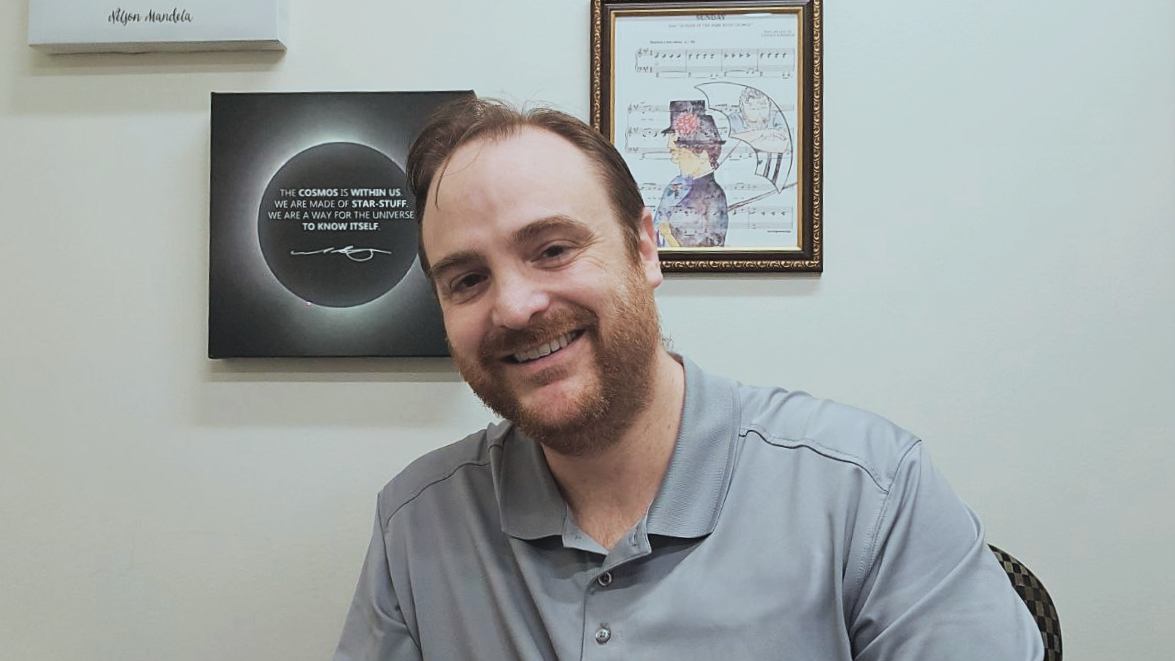
2. How does the cover photo capture who you are?

It’s just me, smiling because I love what I do. But flanked by a couple pieces of wall decor that speak a lot about how I am.
My favorite wall hanging I couldn’t include in the picture because of where it’s positioned on my wall, but it’s a replica of the cover that we sent out with the Voyager 1 Golden Record.
3. In one sentence, what are you trying to change?
I’m trying to do all I can to nudge our collective trajectory toward *better*.
4. What did you notice was broken that made you start writing?
I recognized that something is happening that is truly monumental.
We’re undergoing a shift driven by technology, intelligence, and human coordination that will reshape what it means to be a person—and we’re mostly treating it like a trend.
5. If you could manifest a brighter tomorrow, what would be different by 2030?
That each of us can clearly see what was before and why, and what is coming and why.
That we’ll begin to understand what we’ll be giving up if we choose to regress, and what we can attain if we choose to finally set aside the demons that plague us, in favor of those better angels.
6. How would your closest friends describe you?
Dedicated and hard working. To a fault. I exhaust myself a lot.
7. What’s a challenge that changed how you see the world?
When I was in high school, I struggled to communicate well.
I often made people feel awkward. I had no intention, and often no conception, of this. When I learned I had been pushing people away for years, I was crushed. I had friends, very close ones, but I guess they were the people who stuck around long enough to understand the actual intention behind what I would say.
Realizing I had been driving people away made me want to work hard on my communication skills, which I did. I’m the better for it.
The experience helped me to truly understand that intention matters. My intention was never hostile, but people took it that way. Their intention was never to hurt me, they were protecting themselves. If both parties take just a little bit of time to actually understand one another, it would solve a lot of problems, save a lot of heartache, and spread a lot more joy.
It led to one of the main mantras of my life—give your best, and assume the best in others.
8. What are you most proud of right now?
I’ve been doing The Century Report for a while now, and readership/viewership of that daily release has been growing steadily on various platforms.
I’m also involved in other podcasts and have been producing/content creating several different things. I’ve also been presenting on AI at various Summits and conferences, and working with many different clients to help improve their AI skills.
I’m proud that my work increasingly sits at the intersection of teaching, building, and protecting—helping people gain real skills and agency as we embark into a future that will be nothing like any of us expected.
9. On hard days, what kind of signal from your readers keeps you going?
Knowing that we’re all in this together, and spreading the positive messages of betterment, truth, and love: that’s how we nudge the trajectory toward better.
Hearing stories of people developing themselves, working on their Seeker, Builder, or Protector skills, preparing for the work it will take/is taking to reach that better future, knowing that maybe I can help with that.
10. For people who haven’t seen your work yet, what article would you want them to read first and why?
This decade will be hard. Not hard like “inconvenient” – hard like the opening montage of every disaster movie, the part where everything familiar starts sliding away. People, very likely you and I, will lose livelihoods. Identities built on credentials will crack. The anxiety we feel about this is real, the losses are real, and they are coming. Anyone who tells you the transition will be painless is selling something.
But unlike those movies, we’ll realize that what’s sliding away is a system we no longer need. Because here’s what else is true: contractions precede birth. The squeeze is not the destination. It’s the passage.