“I don’t wish people happiness, I wish them wholeness.”
Jennifer Hong | Author of Natural Intelligence
1. Tell us about you.
A bit of a nomad – raised in California, 15+ years in NYC, a chapter in London. I’m back in San Francisco after 18 months in Boston.
Everyone in my family has a PhD except my mom and me, which made science the background music growing up. A CEO once called me a “social scientist,” and it stuck – my studies span social welfare, sociology, marketing, and analytics.
I’m into everything from branding and fashion to wellness, spirituality, pop culture – and these days, AI. The throughline is the “why” behind things and the view behind the scenes: how a brand evolves, how culture shifts, how tech mirrors humanity.
I love contradictions – but I’m also aware of how perception becomes reality. Maybe that’s why I embody a few. If I’m a nerd, I want to be a cool nerd. If I can wear heels and a dress, I also want to surprise in camo streetwear. I’m into luxury branding but also consider myself a low-key Buddhist. Desire and detachment, coexisting. Most people think I’m chill. If you really know me, I’m decidedly not.
My social bio used to say “I’m a lover, not a fighter,” across platforms and for decades. But I’ve recently had to amend this. I’m a fighter because I’m a lover. They were never opposites. One is the engine of the other.
I’ve been fighting my whole life – in high school/college it looked like classic rebellion, in my work it meant a seemingly nonsensical career switch. That protest, resistance shows up everywhere for me, even in my body and my romantic life.
Also some shorthand: Aries Sun, Capricorn Moon, Cancer Rising.
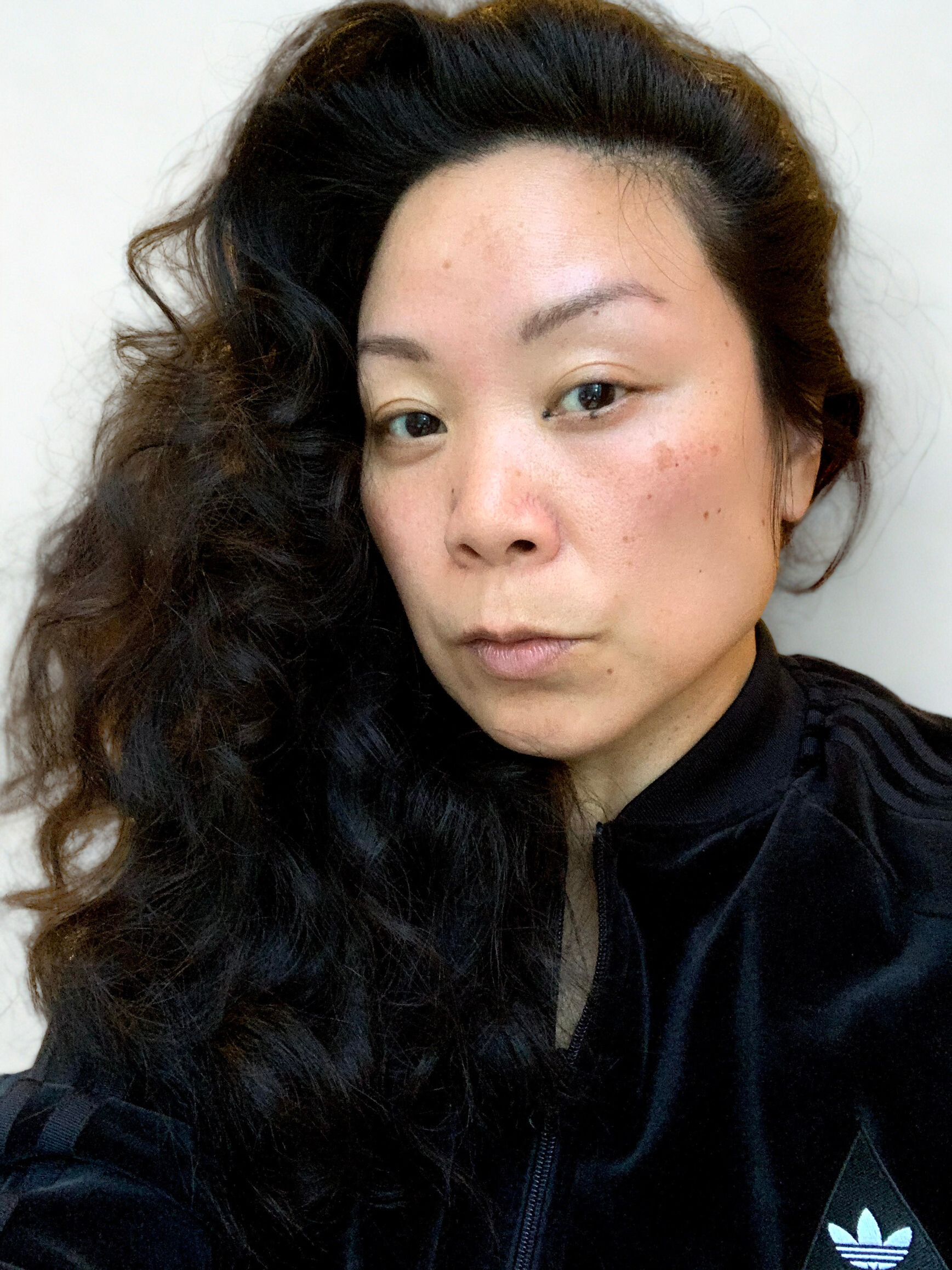
2. How does the cover photo capture who you are?

I was attending a virtual fashion show and needed to represent my company, so I got presentation-ready.
Zoom fashion Jennifer.
I picked this dress specifically because the collar would be visible. All effort above the neckline.
3. In one sentence, what are you trying to change?
I want life to feel easier for everyone – and I think understanding what we build reveals what we’re still figuring out.
4. What did you notice was broken that made you start writing?
When I started writing, essays poured out of me like water. I realized AI was revealing all the challenges we face as humans – it was becoming an “easy button” for things that had become hard (work, dating, therapy, medicine). It says so much about the state of the human condition.
Lately I’ve been writing Substack meta commentary – digital relationship dynamics, how the algorithm works. My first job was in quantitative risk analytics for institutional investors, and I never thought it’d become useful as a marketer. Predictive risk profiles are basically media mix modeling.
Performance attribution is just marketing attribution with different labels. These posts are highly engaging, which tells me everyone is confused by the same things: are digital behaviors comparable to analog ones? How does this algorithm actually work?
I’m highly suspicious of Substack’s “Growth” tab. It assigns each subscriber a single source, but doesn’t disclose whether that’s first touch or last. Views can be inflated. “Direct” traffic is a black hole. Open rates are unreliable thanks to Apple Mail. Some of your most engaged readers might appear inactive. I’ve seen folks cull their lists based on low engagement scores. Please don’t.
On a personal front, I’d been consuming content for too long. The outpouring showed me I had a pent-up need to create. Writing helps me make sense of what’s broken: at a macro level, at a platform level, and for me personally.
5. If you could manifest a brighter tomorrow, what would be different by 2030?
Today, basic living is expensive, healthcare is inaccessible, and “fulfillment” can sound like a luxury. That’s exactly why I’d manifest it.
Everyone operating from their most fulfilled self – where health is optimal across mental, physical, emotional, and fiscal dimensions, and where strong relationships across family, friends, romantic, and career aren’t aspirational but baseline.
My definition of being whole includes the heights of happiness accompanied by the depths of sadness. That’s not a flaw – it’s the reality, the full experience of life.
I don’t wish people happiness, I wish them wholeness. But, yes, the foundation has to be there: health and strong relationships.
The systems aren’t built for that yet. But the people can be.

6. How would your closest friends describe you?
I don’t like to assume, so this is straight from some real sources, albeit the west coast version (it’s 9:03pm PST so I didn’t text anyone in a sleeping time zone).
From a high school bestie:
“Meticulous, gift giving is your love language, very clean and organized, very intelligent. Into horoscopes. Reflective. A planner. AI enthusiast. Cat mom.”
From a college bestie:
“Jenn is smart, stylish, and calm under pressure, the kind of person who can take everything in stride and be a rock for the people around her. She handles whatever comes her way with grace, thoughtfulness, and confidence, and people naturally turn to her when they need someone they can rely on.”
(Sidenote this is the text that followed: “I just had a 45 minute conversation with ChatGPT, because I feel like I can’t express what a wonderful person you are. This doesn’t do you justice. You’re one of my best friends, and I’m so lucky to have you in my life: no matter what, you’ve always been there for me, and I love hanging out with you and spending time with you. I just don’t know how to say all that to make it sound professional for something like Substack.”)
She doesn’t know my version of Substack is not totally professional 😏.

7. What’s a challenge that changed how you see the world?
It took a series of mini life-crises to make me believe what I already knew.
I’ve written about this – when you a) leave a job, b) have surgery, and c) break up with your partner in rapid succession, you start realizing how you really define yourself. I had always given advice I wasn’t taking myself. That’s the difference between knowing and believing. Something along the lines of “you’re not defined by your [fill in the blank: title, body, relationship].”
I try very hard not to root self-worth to external anchors: job, marital status, optics.
To tie this to Substack – it’s challenging, but I don’t want to look too hard at my subscriber growth and engagement. It’s a battle of wills though. I have decades of experience analyzing what creates growth. Of course I’m going to apply it here. But I have no sights on being a “funnel bro.” And because of my answer to question #4, it’s a bit of a fool’s errand to spend too much time trying to hack growth here anyway.
8. What are you most proud of right now?
For someone who built a career on making people want things, I’ve become decidedly less consumerist. When you move a lot and touch every item you own multiple times, it literally makes you take inventory.
I had to produce one for insurance purposes. 82 dresses, 65 sweaters, 16 sunglasses. Seeing it written down was 👀.
It makes me wonder about my career. It’s often said “marketers are the most easily marketed.”
I was living proof – accumulating a wardrobe that only made sense for a specific era in NYC, and single-use kitchen implements I used exactly once (yes, I own an apple coring tool and a dough whisk). In the last 5 years I’ve done multiple edits, donations, resales.
One thing hasn’t changed: I’ve only ever wanted to market quality products. It’s what drew me to luxury – the craftsmanship, the heritage, they’re indisputable.
My current project, the founders’ stories will bring a tear to your eye and you can feel/see the quality of their designs, their fabric choices. I have no qualms helping them win, telling their story to anyone who will hear it.
So I’m proud of reducing my footprint and not accumulating more. Of investing in experiences and creation over things. And of only marketing products and stories that deserve it.


9. On hard days, what kind of signal from your readers keeps you going?
When someone says “this resonates,” or “I was nodding my head the whole time,” or comments with their own take that mirrors what I was trying to convey – that’s it.
If I’ve put words to something someone else felt, I’m good.
It connects to something I’ve been thinking about lately. I recently revisited my Ikigai, not the Western Venn diagram about career/passion/income. Authentic Ikigai is a portfolio of meaning distributed across all areas of life. (Shout-out to @petertaylorbrown who sent me the Medium article that explains how the Western appropriation took place.)
As one sentence, [my Ikigai] is: Finding meaning in the moment scattered pieces become whole – and holding space for others to find theirs.
Substack comments are how I hold space.
10. For people who haven’t seen your work yet, what article would you want them to read first and why?
Love Is Blind: Substack Edition
It’s the most me. AI + pop culture + taxonomy + “please stay human in this algorithmic hellscape!”
BONUS Q: If you could recommend another writer to be featured on Not Rising, who would it be and why?
From one pattern recognizer to another, his writing connects dots between design, behavioral science, and technology in ways that make you rethink how you approach your own work. He makes complicated things genuinely digestible without ever dumbing them down. A favorite that the algorithm hasn’t found.
